
Cruising on J-Pal's website (as I do in my spare time), I ran across this chart detailing the cost effectiveness of different interventions on teacher absenteeism. See if you can spot the outlier:
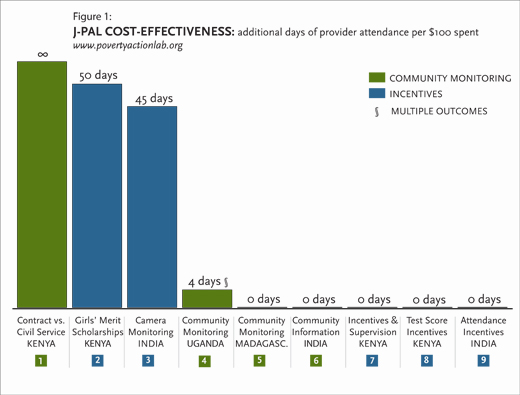
That's right, contract teachers offer infinite cost effectiveness (you'd think that the bar should go a little higher).
The reason that J-PAL asserts contract teachers have infinite cost effectiveness is because they are trading off against regular civil service teachers, so a more productive, cheaper option is being swapped out for a less productive, more expensive option. So you increase effectiveness and save money.
While intuitive, this interpretation is a little bit misleading. Most interventions do not consider trade-offs: when we look at the cost effectiveness of deworming, we don't consider the cost-effectiveness of simultaneously dropping another, less effective option. Using this approach, we could probably give any intervention infinite cost effectiveness.
It's not unreasonable to consider the trade-offs to contract teachers (the intervention is a trade-off by default) in calculating cost effectiveness, but it isn't really comparable to the other measures.
2 Comments
Good point. Any suggestions for how to do the same comparison more equitably?
Ideally you'd look at teachers as a stand-alone intervention (going from having no teachers to contract teachers). That, understandably, sounds a little daft, but is more comparable to stand-alone interventions like deworming, etc. Or just consider it without the opportunity cost (which is negative) of not hiring a government teacher. nnMaybe I'm being a bit harsh - they do explain why the value is infinity, but infinity in itself doesn't tell us very much.