
Terence at Waylaid Dialectic rightfully voices a common concern held by many involved in development, but one that is usually reserved for mildly paternalistic banter around the ambassador's dinner table:
Quick thought: if the respective focus of development work was proportionate to the actual magnitude of the problems experienced in developing countries, we would spend *a lot* more time working on alcohol related issues.You don't have to spend much time in some developing countries to realise that poverty and heavy drinking are often severely correlated, and that heavy drinking has extremely adverse consequences for both the drinkers themselves and their families. It's enough to get public health wonks worried - and for good reason.This isn’t a Kristof type argument — i.e. poor countries are poor because people spend too much money on alcohol — but rather a reflection on the inescapable fact that in poor countries alcohol causes major problems, particularly for the poor. And particularly for the poor women and children who have to deal with the consequences of their husbands drinking.
Yet, as popular as the African-man-sitting-around-drinking-as-the-wife-tills-the-fields-and-starts-a-microenterprise stereotype is, I'm a little skeptical about the leaps of logic used to translate these concerns into policy recommendations. I have, for example, often heard this stereotype used as an excuse to favor interventions which bypass men in the household, such as cash transfers directly to the female head of the household. Shifting the bargaining power in favour of women is undoubtedly a good thing in most contexts, but consider, for a moment, some of the reasons why men might end up as heavy drinkers.
Could it just be the sheer distress of being very poor, or perhaps low expectations and aspirations leading to a general lack of ambition? If it is the latter, shouldn't we think more about investing in opportunities for men, such as job growth? I know of at least one ongoing study (trying to randomise job opportunities for men in Ethiopia) which could test this hypothesis. Is anyone aware of any credible studies on this?
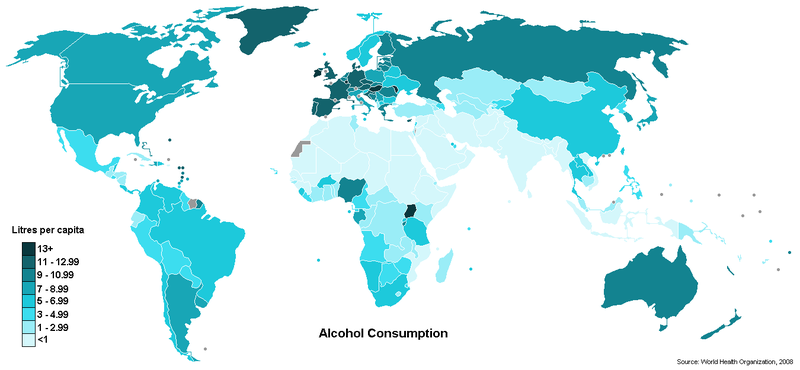
And finally, in case you think heavy drinking is a low-income phenomenon (although, I'd be interested to see what the Engel curve for alcohol looks like):
3 Comments
Yes - I can't remember who, but someone recently wrote a great piece about the actual experience of being in poverty - it's extremely boring and often very stressful, and most alcohol drinkers find a snifter of something strong helps relieve or at least dilute the intensity of both of these emotions.
Bear in mind as well that super-strong booze in most African countries is incredibly cheap. It's not like a poor farmer is buying a bottle of tusker - he's more likely to be drinking a pombe of some description, often maize beer - which, like Guinness, has some nutritional value.
"I have, for example, often heard this stereotype used as an excuse to favor interventions which bypass men in the household, such as cash transfers directly to the female head of the household."
It's more than a stereotype though, or at least it seems to be here in Honiara, where the men are almost exclusively the ones drinking.
I agree that the correlation between poverty and alcohol intake, to the extent that it exists, is probably driven by the stresses of poverty leading to drinking more than it's driven by drinking leading to poverty. Although, the question would then by: why men? and why don't women drink more? I'd imagine that the stresses of poverty effect women every bit as much as men don't they?
As for what is to be done, rather than interventions to bypass men, in my case I'd simply like to see some research, and then action, aimed at trying to help try and reduce the level of (and negative impacts of) excess alcohol consumption.
For what it's worth this is exactly what I'd like to see done in New Zealand too.
On the health effects of alcohol front, I've heard public health researchers decry the lack of attention / disinterest in alcohol-related health problems in the US too, as compared to morbidity/mortality related to smoking, diet, etc. I'm not sure anyone came up with definitive answers as to why alcohol gets relatively less attention, but it's certainly not a phenomenon that's limited to the developing world.