I've blogged and commented about the rarity of revolution in Africa, so the very under-reported events in Tunisia have captured my interest.
Now the NYT is reporting that the President has fled the country and the Prime Minister has claimed power, constitutionally.
I find this fascinating for two reasons. Firstly, the Prime Minister is a close ally of the President and seems to immediately have become the focus of a new campaign of removal:
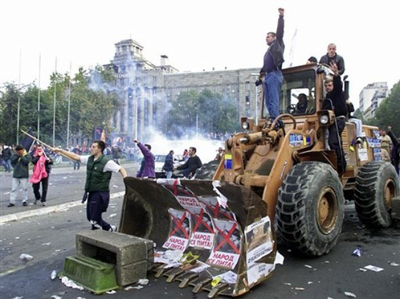
Yet by late Friday night, Tunisian Facebook pages previously emblazoned with the revolt’s slogan, “Ben Ali, Out,” had made way for the name of the interim president. “Ghannouchi Out,” they declared.This is one indication that there is no popular figure who the riots are aimed at pushing into power: it is solely a vehicle to express discontent. This contrasts with, for example, Serbia's 'Bulldozer Revolution' which removed Slobodan Milosevic in favour of the winner of the previous elections Vojislav Koštunica.
Secondly, I'm having real difficulty in identifying leadership of the riots and demonstrations. This could simply be my ignorance about the situation, since the coverage here has been so patchy. However, to my mind, revolution has a defined aim and defined leadership. Is this then a revolution? Or a different kind of political upheaval? And what will be the final result? Elections (which will take at least a month or so to organise)? Or is there a popular leader ready to take power? Can someone who knows more about this please enlighten me?
1 Comment
We have in our history another example of a country where none of the politician were appropriate for the job as president. To come around that question, they elected a playwright. A man of philosophy. Vaclav Havel.
Don't Tunisia have a poet or writer that would like the job?