
Most governments enjoy the ability to rely on eminent domain whenever land needs to be acquired for large scale development projects. China, a country where one would expect this sort of power to be exerted all the time, appears to be home to a surprising number of `nail houses' - property where owners refused compensation from private investors and refused to move out. If the government doesn't exercise eminent domain and compensation cannot be agreed on, investors often go ahead anyway and build around the remaining property. There result is striking and more than a little funny - I stumbled across this collection of photos of Chinese nail houses (and a few from the US and Europe) on io9 - a few examples:
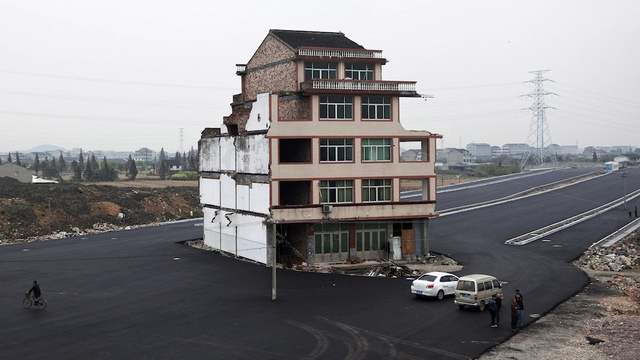

It's hard to know how to feel about these situations. For the past few years I've been working on a project that has been trying to extent formal property rights to slum residents in Dar es Salaam. I've often sold the benefits as being primarily expropriation-related, but several seminar attendees have (rightly) pointed out that sometimes it's better off for society if people can't, on the margin, hold out for enormous compensation amounts. This opens up the enormous can of worms which is the rights-versus-efficiency debate, something I'm not going to get into at the moment. Yet, it's still worth pointing out that this issue is far from straightforward: we want large investment projects to be successful, and to do so they need land. We also don't want to trample on the rights of owners, especially the poor, especially when compensation is often neither fair nor transparently handled.