By Carmine Paolo de Salvo
In this guest post, I wish to focus on my direct experiences of a famous experiment in development, one which is meant to bring prosperity and progress to those that have never experienced it. I refer to the Grameen Bank in Bangladesh, and I am sure that the readers of this blog will know what the Grameen Bank is, so I don’t need to spend any time explaining it.
As with many people around the world, my interest in Grameen Bank was triggered by the award of the 2006 Nobel Peace Prize to it and to its founder, Dr. Muhammad Yunus. After reading “The Banker to the Poor” (Yunus’ bestselling autobiography) and finishing my studies, in September 2009 I went to the Grameen Bank headquarters in Dhaka, Bangladesh, to spend there a month as an intern.
What I want to do in this post is to compare briefly what I had read in Dr. Yunus’ book and what I actually was able to see during my experience in Bangladesh. I honestly believe that in the book there is little that can be considered false, but, at the same time, the impression that Yunus gives of the Bank’s activities is, in some respects, misleading. My opinion, of course, is not based on any robust statistical evidence, but was rather built directly in the villages in which Grameen operates, among real people, notwithstanding the limiting but necessary presence of an interpreter (I’m not so fluent in Bangla, sorry!). I am not going to share my ideas on the classical critiques that are raised against microcredit (in particular the level of interest rates due to high management costs and the support it gives to a petty form of entrepreneurship, which many don’t consider helpful) because they are already well-known and it would take me too long to repeat them here. I will instead limit my comments to three points that caught my attention and on which I would be interested in hearing feedback from others with greater expertise in the field.
Specifically, my points are:
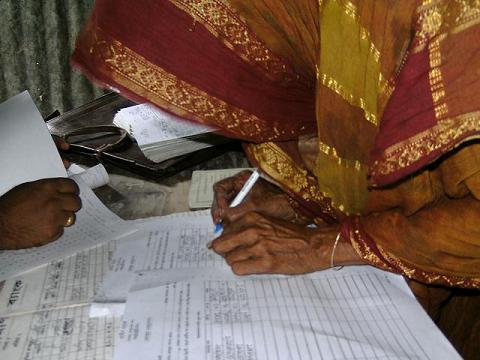
- The absence of support to female entrepreneurship, something which is constantly underlined in the book and in everything I read about Grameen’s action as a central feature of its action. It Is completely true that women are the legal holders of the loans and that they physically receive the money, but it is also the case that, a few seconds after receiving it, they pass it on to the father or the husband of the household, who waits in the bank a few metres behind them (I personally saw this scene many times). These women don’t practice any economic activity (as frankly admitted by even some rural Grameen officers). They remain housewives as before, but now they also have to bear the burden of the loan that they have to pay back, whose use they have basically no control over. This does not seem to be a great improvement in their life, I would say. Of course, the fact that they meet with each other on a weekly basis is without any doubt a means for them to overcome their social segregation, but the deep revolution I had read about in the book and in other articles, in my opinion, does not exist.
- Many of the women that receive the loans are illiterate and some of them don’t even have a clear idea of what the concept of a “year” means. Moreover, sometimes they don’t even know how much money they have actually borrowed. Therefore, I seriously wonder to what extent these people are exposed to the risk of exploitation by the officers that operate in those remote rural areas. Who can control them? Nobody, it appears, and to trick these people, given their conditions, is extremely easy. I can’t of course prove that these misbehaviors are a reality, but I think it is wise to take into account the possibility that they do exist. Of course, Grameen Bank as a whole would not be considered guilty for the misbehavior of any individual employee, but it is legitimate to think that, maybe, the enchanted world described in the literature might not match reality in at least some concrete situations.
- The role of savings, which is ambiguous. Grameen Bank’s biggest pride is that its loans are disbursed without any request of formal collateral. Anybody that has access to its loans is, however, required to open a savings account. On questioning, some Grameen officers have admitted that in cases of insolvency, the bank can actually access these savings and repay the loan through them, even though this is the last resort. Despite the official declarations, if these savings don’t represent a form of collateral, they are very close.
Despite these observations, I would like to make clear that I consider, on the whole, that the Grameen Bank is a good thing, and I believe that its impact on the rural populations of Bangladesh, who previously did not have access to any form of credit, is beneficial. What does not convince me at all, though, is the description of Grameen’s activities as a social revolution, the beatification that has been afforded to Dr. Yunus, and the hagiographic tone which accompanies most discussions about Grameen, not least in the way Grameen itself talks about its activities.
This final image might summarize my thoughts: at the ground floor of the Grameen skyscraper in Dhaka there is an exhibition to celebrate the Nobel Prize. Visiting this exhibition, believe me, there is one thing that one can never be in doubt of: that the Nobel Prize was given because of their humility.
A similar version of this post will be published, in Italian, on the blog "iMille", www.imille.org
The opinions I have expressed here are the result of many profitable discussions I had with other interns I met in Dhaka and in particular with my dearest friend, Cecilia Ragazzi, who shared this experience with me. It is fair to admit that my ideas were influenced by her fruitful contribution and I am glad to thank her publicly.
Carmine Paolo De Salvo is an economist working as an ODI Fellow at the Ministry of Finance and Economic Affairs in Zanzibar. Currently, he focuses on national planning and poverty reduction strategies.
1 Comment
A film just premiered at Sundance about how the Grameen Bank model is being implemented in New York City. It’s called“To Catch A Dollar: Muhammad Yunus Banks on America.” Might give an interesting perspective... The film's website is tocatchadollar.com.